
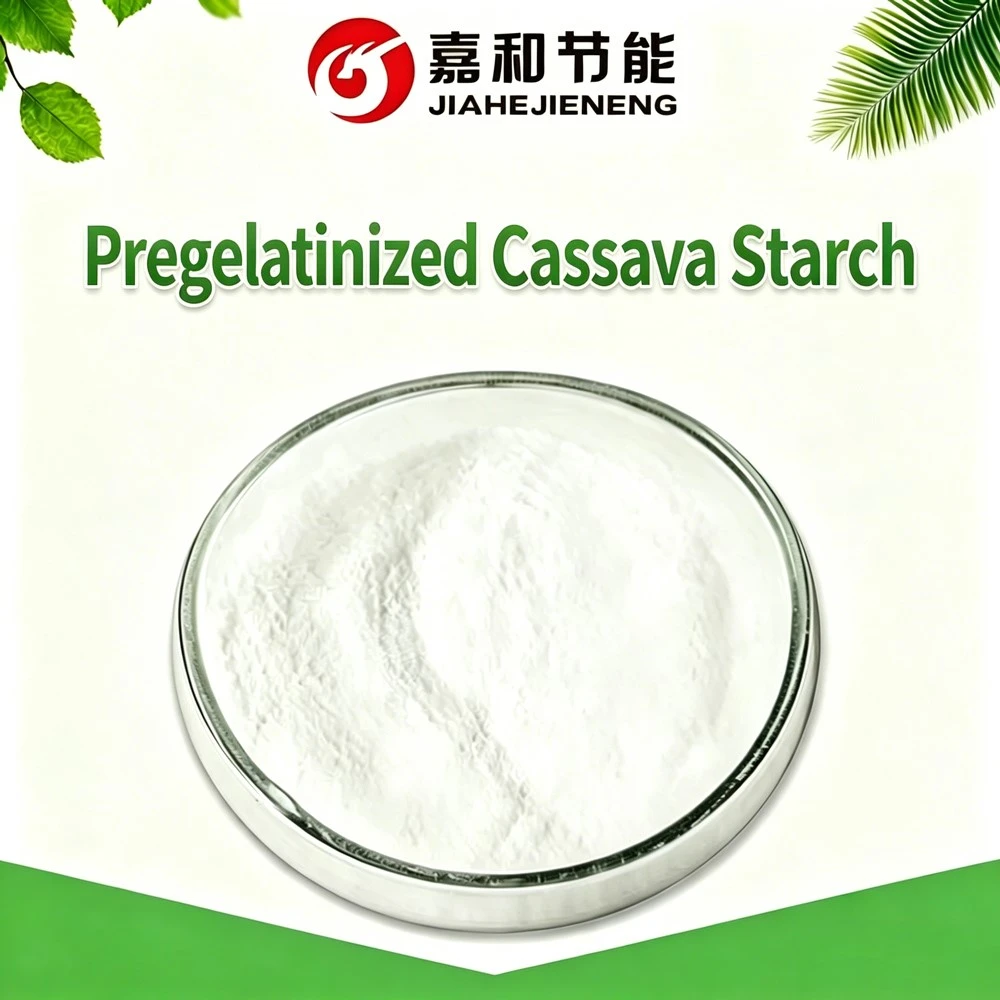
Pregelatinized Cassava Starch is a premium specialized bonding raw material widely adopted in industrial and civilian fields. It accommodates most bonding-related production processes and ranks among the most practical and versatile starch-based bonding materials currently available, fully meeting basic and mid-tier bonding requirements across diverse industries. Compared with raw starch and pregelatinized corn starch, it delivers notable advantages in bonding performance and perfectly suits production procedures that require adhesion, shaping, solidification and material agglomeration, covering a broad range of mainstream industrial application scenarios.
In terms of core product properties, Pregelatinized Cassava Starch is processed through high-temperature pregelatinization technology that completely breaks down the original particle structure of raw starch. Unlike conventional starch, which requires high-temperature boiling and heating for gelatinization, this product can dissolve and activate rapidly in cold water at room temperature to form a high-viscosity, high-adhesion paste colloid. Its instant activation eliminates the need for heating equipment in bonding operations, simplifying production procedures and reducing energy consumption and labor costs. It is highly versatile and applicable to both large-scale assembly line production and small-scale workshop processing.
In terms of bonding performance, the colloid formed by this product provides uniform and long-lasting bonding strength. It develops initial viscosity quickly to bind loose materials and achieve preliminary shaping within a short period, significantly improving production efficiency. After full curing, the bonding layer exhibits excellent toughness and adhesion, effectively preventing cracking, peeling, loosening and powder shedding to ensure the compactness and flatness of finished products. Furthermore, its fine, smooth bonding texture contains no granular impurities, delivering smooth material surfaces without compromising the appearance or basic performance of final products.
In practical application scenarios, it is widely used in putty powder, thermal insulation mortar and bonding mortar within the building materials industry to bond aggregates, retain moisture, stabilize shapes and resist cracking. In the incense manufacturing industry, it serves as a core bonding raw material to adhere incense sticks and powder, producing firm, break-resistant incense that burns evenly. In the feed industry, it bonds powdered and granular feed materials to prevent pulverization and improve pellet forming rates. In the paper and woven goods industry, it supports paper adhesion and woven bag sizing to enhance structural stability. It also adapts to powder bonding and shaping processes in ceramics, metallurgical powder, daily chemical powder and other sectors.
Additionally, this product boasts strong compatibility with common raw materials such as fly ash, talc powder and calcium carbonate, maintaining stable bonding performance without material rejection, performance failure or caking. It features high purity, no odor, non-toxicity and environmental friendliness, causing no adverse effects on finished products. Compared with alternative bonding materials, it offers outstanding cost performance, stable storage performance and strong deterioration resistance, with no decline in bonding performance during long-term use. As a preferred material for various bonding scenarios, it fulfills nearly all medium and low-strength bonding requirements in industrial production.